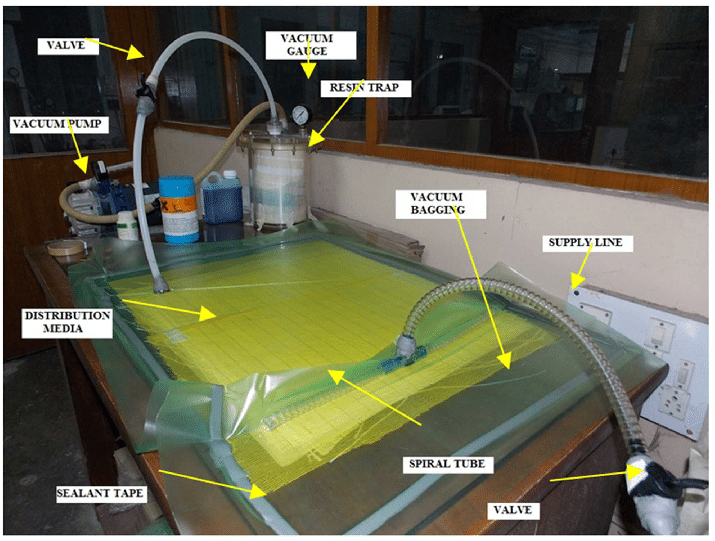
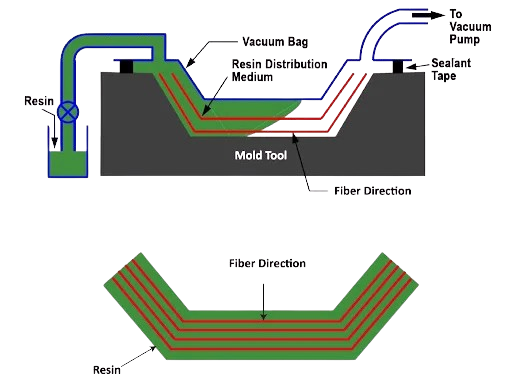
Vacuum-Assisted Resin Transfer Molding, or VARTM, provides a solution for more intricate parts such as radiused and flat pole collars, surge rings, flange rings, fan baffles, stator end caps, flat discs, and rings. VARTM stands out from the other resin transfer molding processes since it does not need the use of heat or pressure. Rather than pumping the resin using pressure, the VARTM draws it into the preform using a vacuum.
Thus, VARTM uses low-cost tools, making it easy to produce many inexpensive and complex parts.
VARTM molded composites are created where mechanical and dielectric strength are required in complex shapes and surfaces. Temperature ratings currently include 130°C and 155°C (Class B and F). Prazastinav Compositech can produce various custom geometric shapes and sizes via VARTM. The composite resins and fabrics can also be altered to meet the application’s needs. Examples of this could include using different fabrics and reinforcing fibers such as S-Glass, Carbon fiber, or Kevlar to create higher-strength composites in complex shapes.
VARTM also provides fiber orientation contoured to the shape of the part. If a part is machined from a flat composite sheet, fibers are only oriented in the x-y plane, which can create weak spots in a 3-D contour
Prazastinav Compositech can produce various custom geometric shapes and sizes via VARTM. The composite resins and fabrics can also be altered to meet the application’s needs. Examples of this could include .... using different fabrics and reinforcing fibers such as S-Glass, Carbon fiber, or Kevlar to create higher-strength composites in complex shapes.
VARTM also provides fiber orientation contoured to the shape of the part. If a part is machined from a flat composite sheet, fibers are only oriented in the x-y plane, which can create weak spots in a 3-D contour
.
Read more
Advantages of VARTM
It is adaptable in terms of tooling design and material selection
Process bulky and complex composite parts with improved quality
Mold may be easily altered to process various shapes
Optimal wet out of the part due to vacuum process (i.e., eliminating air voids)
Separately stored resin and catalyst can be combined just before resin infusion
Low volatile organic compounds (VOCs) emissions occur only during the resin mixing process
Structural and bearing strength advantage
VARTM offers numerous cost advantages over traditional RTM, such as lower tooling costs and shorter start-up time. Because the top half of the tool is a flexible vacuum bag, a matched metal mold is no longer required. This makes VARTM attractive for the manufacture of large components. Along with the advantages, VARTM also has inevitable disadvantages. It is a relatively complex process to perform well. The flexible nature of the vacuum bag makes it difficult to control the final thickness of the preform, and thus, the fiber volume fraction of the composite.
Products Manufactured - with this application:
Aircraft Fuselage Sections
Aircraft Landing Gear Doors
Large Composite Panels
Wind Turbine Blades
High Fiber Content Parts
Boat hulls
Vehicle body panels
Défense parts
Special effects props & mannequins
Prototypes & development models
Carbon Fiber
Low Void Content Parts
Industrial components
Waterslides & diving boards
Aerospace components
At Prazastinav Comositech we specialize in Vacuum Assisted Resin Transfer Molding (VARTM) techniques. With years of experience with manufacturing and design, we can design a mold and process around your particular requirements. We are one of India’s highest-volume producers of infused parts.
We have experience working with many different resin systems including polyester, vinyl ester, and epoxy. We have also worked with glass, carbon, and aramid textiles for various projects. We offer expert advice in making the most out of your infusion part and are able to cater materials and processes to your particular needs. Our dedicated team can complete both small and large production runs and sustain high-volume throughput at a competitive price.
Manufacturing carbon fiber components with vacuum-assisted resin transfer molding (VARTM) involves placing the carbon fiber material on a tool under a vacuum bag, pulling a vacuum on the bag, transferring the resin by vacuum into the fiber, and curing the composite under heat and pressure. This process results in strong and lightweight parts that are well suited for use in a variety of applications. VARTM is best used for the production of parts with complex geometry, such as sailboat hulls or motorcycle faring because the process allows time to carefully lay the carbon fiber in the tool before mixing and applying the resin.
Flat parts such as large sheets and plates can be molded less expensively via resin transfer, but the surface finish is not as beautiful. The individual carbon fiber tows have a flattened appearance where the texture of the individual fibers is less visible.
In conclusion, when choosing a carbon fiber manufacturing process it is important to weigh the pros and cons of each process. The best manufacturing method for a particular application will depend on factors such as the size and geometry of the part, the quantity to be produced, and the desired properties of the finished product, such as high tensile strength.
Working with a qualified firm that has extensive knowledge of carbon fiber manufacturing methods is imperative when embarking on a project. Leveraging deep experience in material sciences, composites, and thermosetting processing, Prazastinav Compositech empowers leading brands to create innovative, high-performance, sustainable products at scale using Glass fiber, Carbon Fiber, Aramids, Kevlars, and advanced composites topologically optimized for the process designs.